


eCommerce data tracking is essential for businesses that want to make informed decisions, optimise marketing strategies, and protect online sales. Accurate tracking enables brands to understand how customers interact with their websites, measure campaign effectiveness, and identify growth opportunities.
However, as digital privacy regulations evolve and traditional tracking methods become less reliable, businesses face increasing challenges in maintaining trustworthy data.
What is eCommerce Tracking and Why It Matters
eCommerce tracking is the process of monitoring customer activity on a website to collect data on behaviour, conversions, and revenue. It allows businesses to measure how campaigns perform, understand purchasing patterns, and tailor marketing strategies accordingly.
Reliable eCommerce web tracking ensures that decisions are based on accurate insights rather than assumptions. Without it, brands risk misallocating budgets and misjudging the impact of their campaigns, which can hinder growth and profitability.
Why Traditional eCommerce Data Tracking Is Becoming Less Reliable

The reliability of traditional tracking is declining due to several factors. The phase-out of third-party cookies by major browsers, including Safari and Chrome, has limited the ability to monitor customer interactions over time. Apple’s Intelligent Tracking Prevention, for example, restricts third-party cookies to just seven days, creating gaps in eCommerce data analysis.
Privacy concerns and the growing use of ad blockers further reduce data collection. As users become more aware of how their data is used, they are increasingly opting out of tracking, leading to incomplete insights. These changes highlight why relying solely on old tracking methods is no longer sufficient for accurate eCommerce data tracking.
Server-side tracking offers a more reliable alternative. By collecting data directly from the server, brands gain access to more accurate eCommerce sales data and better control over customer data tracking, helping maintain insights even in a privacy-focused environment.
The Impact of Unreliable Data on eCommerce Brands
Inaccurate data can have far-reaching consequences for eCommerce brands. Inaccurate attribution is common when customers interact with multiple marketing channels before making a purchase. For instance, a customer may first click on a social media ad but purchase days later via organic search. Without reliable eCommerce data tracking, the sale may be misattributed, underestimating the value of the initial campaign.
Misleading ROI calculations can also occur. A campaign might appear unprofitable due to incomplete data, leading to poorly informed budget decisions. Additionally, incomplete insights can result in missed opportunities to optimise campaigns, enhance targeting, and improve customer experience. Managing larger datasets compounds these challenges, as inconsistencies or gaps in data can distort the overall understanding of performance.

Arguments For and Against Tracking
Tracking provides valuable insights into customer behaviour, sales performance, and marketing effectiveness. First-party data tracking is particularly effective, allowing brands to collect data directly from users while complying with privacy regulations. Accurate tracking enables businesses to personalise experiences and make informed strategic decisions.
However, tracking also presents challenges. Privacy regulations, ethical considerations, and the potential for over-reliance on quantitative data can limit its usefulness. Brands must balance the benefits of tracking with transparency and responsible data management to maintain consumer trust.
Tools and Strategies to Secure eCommerce Data
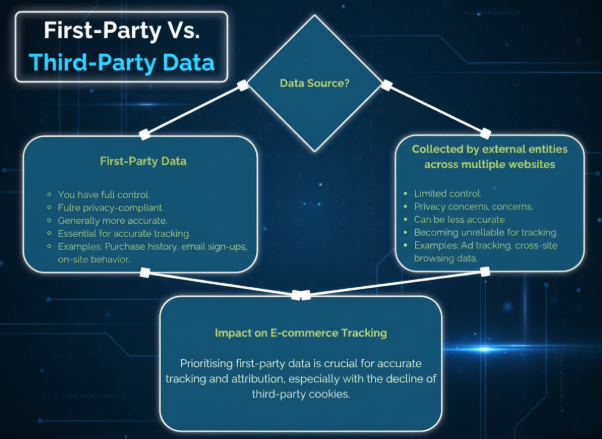
Securing eCommerce data requires a combination of tools and best practices. First-party data tracking should be prioritised, as it allows brands to collect accurate information directly from customers through account registrations, email sign-ups, and loyalty programmes.
Server-side tracking is another key strategy. By capturing backend data, brands can achieve more accurate eCommerce web tracking even when browser limitations or ad blockers interfere. Platforms such as Shopify provide solutions to implement server-side eCommerce tracking effectively.
Customer Data Platforms (CDPs) are also invaluable for consolidating information from multiple sources, offering a unified view of eCommerce customer data. Regularly reconciling data between tools like Google Analytics and advertising platforms ensures consistency and helps brands maintain accurate insights over time.
Turning eCommerce Data into Actionable Insights
Collecting data is only the first step; converting it into actionable insights is what drives results. Brands can analyse eCommerce product data, customer behaviour, and sales trends to identify areas for optimisation. Strategies include personalising campaigns, A/B testing website layouts, and refining customer journeys to increase conversions.
Are you wondering how to use eCommerce data insights? Or how to provide guidance on turning raw data into meaningful actions? By systematically analysing patterns and behaviours, brands can make informed decisions that improve sales performance and enhance the overall customer experience.
The 5 C’s of Data Analytics in eCommerce
A structured approach to data analytics ensures reliable and actionable insights. Following these 5 C’s – capture, consolidate, clean, convert, and communicate – provides a framework for effective eCommerce data tracking.
Capturing data accurately, consolidating it across platforms, cleaning inconsistencies, converting it into insights, and communicating findings across teams enables brands to make strategic, evidence-based decisions.
Best Practices to Future-Proof eCommerce Tracking




To maintain accurate eCommerce data tracking over time, brands should combine first-party tracking, server-side solutions, and CDPs. Encouraging returning visitors and optimising interactions through email sign-ups improves data quality, while regular audits and reconciliation across systems prevent inconsistencies.
These practices help brands adapt to evolving privacy regulations, improve eCommerce sales data reliability, and make data-driven decisions that protect online sales. By implementing these strategies, businesses can future-proof their tracking and maintain a competitive advantage.
Conclusion
eCommerce data tracking is essential for optimising marketing, improving ROI, and understanding customer behaviour. While traditional methods are becoming less reliable, first-party data tracking, server-side solutions, and CDPs provide accurate insights that help brands make informed decisions. By converting data into actionable strategies and implementing best practices, businesses can protect online sales, enhance campaign effectiveness, and maintain trust with their customers.