

On June 1st, 2026, Google Ads is fundamentally altering how campaign budgets work.
Unchecked, campaigns could spend £000’s more than advertisers expect.
Account managers running ads on a limited daily or weekly schedule could find their costs skyrocketing without explicit consent. The platform framework now dictates that all campaigns should operate on a continuous monthly cycle regardless of the specific day scheduling parameters established by the user.
Because most advertisers use post-pay billing tied to credit or debit cards or monthly invoicing, this extra spend could happen automatically. Many organisations will not notice the financial impact until the damage is already done.
Our team recently audited an industrial equipment manufacturer to highlight this exact issue. They established a strict weekday schedule to align with their operational hours, ensuring their sales team was available to answer inbound calls.
The upcoming changes mean their expected ad spend will immediately spike, overspending their allocated marketing funds well before the month concludes.
Google frames this update as providing flexibility to capture demand. The reality is far less generous. It is a pure profit play for the platform at the direct expense of unsuspecting business owners. Restoring proper Google Ads budget pacing requires immediate technical intervention before the June billing cycle commences.
How does Google calculate monthly ad spend?

Historical platform mechanics allowed businesses to calculate costs based strictly on active operating days. If an account manager set a £100 daily limit scheduled for Monday through Friday, the system calculated the monthly spend based solely on those twenty active days. This straightforward approach meant the manufacturer spent roughly £2,000 per month.
The system respected the literal parameters established by the account manager. The new algorithmic approach entirely ignores your specific operational schedule. The platform will now pace towards a full monthly budget cap regardless of how many days your campaign actively runs.
The precise equation applied across all global accounts is 30.4 x daily budgets.
Applying this calculation to our manufacturer completely transforms their financial reality. That same £100 daily limit could now aggressively spend up to £3,040 every single month.
The machine learning system redistributes funds to reach this newly established ceiling exclusively during the restricted active weekday periods.
This change represents a 50% increase in total ad expenditure without generating a single new lead or conversion request approved by the business. Securing a controlled Google Ads monthly spend limit requires understanding that the phrase “daily budget” is officially a myth.
We must now treat the “daily budget” figure strictly as a mathematical lever to control what is in essence, a monthly budget.
How to Avoid Overspend
To revert to the original £2,000 monthly budget, we now need to reverse-engineer the maths.
Instead of “20 days x £100 = £2,000 monthly budget”, the maths is now “£2,000 monthly budget / 30.4 = £65.78 per day”.
Ridiculously, that should now mean that Google Ads will spend a maximum of £100 per day on the days when ads are scheduled.
The principal rule: The maximum spend per calendar month is the daily budget times 30.4. If the month is 28 days or 31 days, the end-of-month spend could be the same.
Budgeting Spend for a Weekday-Only Schedule
- Setup: Daily budget of £100, running on weekdays only (22 active days in the month).
- The Maths: Google uses a fixed annual average multiplier of 30.4 to set your monthly cap (£100 × 30.4 = £3,040). It will aggressively overdeliver on weekdays to hit this target. However, the system cannot exceed 2x your daily budget (£200) on any single day. For 22 active days, the absolute limit of the system is 22 × £200 = £4,400.
- Maximum Spend: £3,040. Since the monthly cap (£3,040) is lower than the absolute maximum daily overdelivery limit (£4,400), Google will throttle the campaign once it hits the overall monthly cap.
Budgeting Spend for a Weekend-Only Schedule
Less likely for most advertisers, but:
- Setup: Daily budget of £100, running on weekends only (8 active days in the month).
- The Maths: Google uses a fixed annual average multiplier of 30.4 to set your monthly cap (£100 × 30.4 = £3,040). It will aggressively overdeliver on weekends to try and hit this target. However, the system cannot exceed 2x your daily budget (£200) on any single day. For 8 active days, the absolute limit of the system is 8 × £200 = £1,600.
- Maximum Spend: £1,600. Since the absolute maximum daily overdelivery limit (£1,600) is lower than the monthly cap (£3,040), Google will never hit its target cap, but it will max out your spend at double your daily budget every single weekend.
Budgeting for Mid-Month Campaign Launches
- Setup: Daily budget of £100, running 24/7. The campaign launches on August 16th.
- The Maths: There are 16 active days left in August. When a campaign starts mid-month, Google applies a pro-rated monthly limit based only on those active days.
- Maximum Spend: £1,600 (16 active days × £100/day). Google protects you from paying more than the standard daily rate multiplied by the remaining days in that partial calendar month.
Mid-Month Budget Increase (£100 to £200)
- Days 1–10 at £100/day budget. On Day 11, the budget is increased to £200/day for the remainder of a 30-day month.
- The Maths: When you change a budget mid-month, Google splits your monthly cap into two distinct, pro-rated periods and adds them together:
- Period 1 (Days 1–10): 10 days × £100 = £1,000
- Period 2 (Days 11–30): 20 days × £200 = £4,000
- Maximum Spend: £5,000. Your final billed cost will legally stop at this combined cap, even if heavy traffic spikes trigger daily overdelivery on the £200 days.
Mid-Month Budget Decrease (£100 to £50)
- Setup: Days 1–10 at £100/day. Days 11–30 reduced to £50/day in a 30-day month.
- The Maths: Google applies the same pro-rated math to both halves of the month:
- Period 1 (Days 1–10): 10 days × £100 = £1,000
- Period 2 (Days 11–30): 20 days × £50 = £1,000
- Maximum Spend: £2,000.
And yes, theoretically, that could mean that your campaign barely runs for the last few days of the month. No impressions, no clicks, no leads.
Budget Shift Consequences
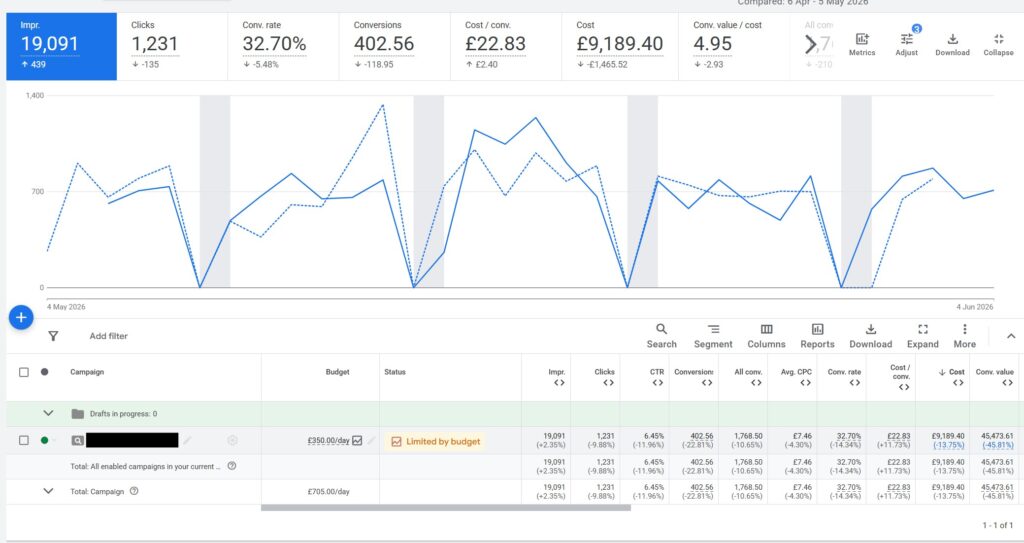
What happens if you don’t change your budget to compensate for the new rules?
Assuming you’re running ads on weekdays and using the example that your original £2,000 budget (old rule) theoretically could spend £3,000, there are a number of outcomes we could reasonably expect.
- Your campaign spend increases by 50%, your cost per conversion (CPA) stays the same, and you get 50% more conversions. You spent 50% more than you expected but also got 50% more leads.
- Your campaign spend increases by 50%, but the economy of scale means that your cost per conversion decreased. You spent 50% more than expected but got 55% more leads.
- Google machine learning uses the extra budget to test new auctions to see if they meet your bidding strategy. Your previous budget cap meant you weren’t included in these new auctions before. These new auctions turn out to be a disaster. Your average CPA increases across the campaign; the conversion rate drops as a result. You spent 50% more but only got 10% more leads.
- Your campaign spend barely changes, and everything stays as it was. It’s possible this could happen, but don’t assume that stays true forever.